Statistic Methods Example
Shilin Zhao
26 June, 2020
EasierStatisticModels.RmdFunctions and packages
## Warning: package 'knitr' was built under R version 3.6.1## Warning: package 'ggplot2' was built under R version 3.6.3## Warning: package 'reshape2' was built under R version 3.6.1## Warning: package 'formattable' was built under R version 3.6.1## Loading required package: Hmisc## Warning: package 'Hmisc' was built under R version 3.6.3## Loading required package: lattice## Loading required package: survival## Warning: package 'survival' was built under R version 3.6.3## Loading required package: Formula##
## Attaching package: 'Hmisc'## The following objects are masked from 'package:base':
##
## format.pval, units## Loading required package: SparseM##
## Attaching package: 'SparseM'## The following object is masked from 'package:base':
##
## backsolve## Warning: package 'htmlTable' was built under R version 3.6.1## Loading required package: data.table## Warning: package 'data.table' was built under R version 3.6.1##
## Attaching package: 'data.table'## The following objects are masked from 'package:reshape2':
##
## dcast, melt## Loading required package: VariantAnnotation## Loading required package: BiocGenerics## Loading required package: parallel##
## Attaching package: 'BiocGenerics'## The following objects are masked from 'package:parallel':
##
## clusterApply, clusterApplyLB, clusterCall, clusterEvalQ, clusterExport, clusterMap, parApply, parCapply, parLapply, parLapplyLB, parRapply, parSapply, parSapplyLB## The following object is masked from 'package:formattable':
##
## normalize## The following objects are masked from 'package:stats':
##
## IQR, mad, sd, var, xtabs## The following objects are masked from 'package:base':
##
## anyDuplicated, append, as.data.frame, basename, cbind, colnames, dirname, do.call, duplicated, eval, evalq, Filter, Find, get, grep, grepl, intersect, is.unsorted, lapply, Map, mapply, match, mget, order, paste, pmax, pmax.int, pmin, pmin.int, Position, rank, rbind, Reduce, rownames, sapply, setdiff, sort, table, tapply, union, unique, unsplit, which, which.max, which.min## Loading required package: GenomeInfoDb## Loading required package: S4Vectors## Loading required package: stats4##
## Attaching package: 'S4Vectors'## The following objects are masked from 'package:data.table':
##
## first, second## The following object is masked from 'package:base':
##
## expand.grid## Loading required package: IRanges##
## Attaching package: 'IRanges'## The following object is masked from 'package:data.table':
##
## shift## The following object is masked from 'package:grDevices':
##
## windows## Loading required package: GenomicRanges## Loading required package: SummarizedExperiment## Loading required package: Biobase## Welcome to Bioconductor
##
## Vignettes contain introductory material; view with 'browseVignettes()'. To cite Bioconductor, see 'citation("Biobase")', and for packages 'citation("pkgname")'.##
## Attaching package: 'Biobase'## The following object is masked from 'package:Hmisc':
##
## contents## Loading required package: DelayedArray## Loading required package: matrixStats## Warning: package 'matrixStats' was built under R version 3.6.1##
## Attaching package: 'matrixStats'## The following objects are masked from 'package:Biobase':
##
## anyMissing, rowMedians## Loading required package: BiocParallel##
## Attaching package: 'DelayedArray'## The following objects are masked from 'package:matrixStats':
##
## colMaxs, colMins, colRanges, rowMaxs, rowMins, rowRanges## The following objects are masked from 'package:base':
##
## aperm, apply, rowsum## Loading required package: Rsamtools## Loading required package: Biostrings## Loading required package: XVector##
## Attaching package: 'Biostrings'## The following object is masked from 'package:DelayedArray':
##
## type## The following objects are masked from 'package:Hmisc':
##
## mask, translate## The following object is masked from 'package:base':
##
## strsplit##
## Attaching package: 'VariantAnnotation'## The following object is masked from 'package:base':
##
## tabulateMake Data
rawData<-matrix(nrow=200,ncol=10,rnorm(200*10))
row.names(rawData)<-paste0("Sample",1:200)
colnames(rawData)<-paste0("Feature",1:10)
rawData<-data.frame(rawData,FeatureYN1=sample(c(0,1),200,replace = TRUE),FeatureCategory1=sample(c("F","E"),200,replace = TRUE),FeatureCategory2=sample(c("A","B","C","D"),200,replace = TRUE),stringsAsFactors = TRUE)

#make data with missing values
rawDataWithMissing<-rawData

set.seed(123)
temp1<-sample(1:ncol(rawDataWithMissing),200,replace=TRUE)
temp2<-sample(1:nrow(rawDataWithMissing),200,replace=TRUE)
for (i in 1:length(temp1)) {
  rawDataWithMissing[temp2[i],temp1[i]]<-NA
}
Notes
#Making formula. Using () to print at the same time
#(formulaForModel<-as.formula(paste0(outVar,"~",paste(varForTable1, collapse=" + "))))
##Logistic regression: Model, Table, and Figure
Model and Table
outVar="FeatureYN1"
varForTable=c("Feature1", "Feature2","Feature3","FeatureCategory1")

nonLinearTest(rawData,outVar,varForTable,modelType ="lrm",returnKable=TRUE)| Outcome | X | Formula | P (Variable) | P ( Nonlinear) | P (TOTAL) |
|---|---|---|---|---|---|
| FeatureYN1 | Feature1 | FeatureYN1 ~ rcs(Feature1, 3) | 0.161 | 0.442 | 0.161 |
| FeatureYN1 | Feature2 | FeatureYN1 ~ rcs(Feature2, 3) | 0.125 | 0.455 | 0.125 |
| FeatureYN1 | Feature3 | FeatureYN1 ~ rcs(Feature3, 3) | 0.315 | 0.143 | 0.315 |
modelTable(rawData,outVars="FeatureYN1",interestedVars=list(c("Feature1"),c("Feature2","FeatureCategory1")),adjVars="Feature3") Formula Event InterestedVar Effect (One Unit) P Odds Ratio (One Unit) OR (Lower 95%) OR (Upper 95%) Value (25% Quantile) Value (75% Quantile) Value Diff (75%-25%) Odds Ratio (Diff: 75%-25%) OR (Diff, Lower 95%) OR (Diff, Upper 95%)
1 lrm (FeatureYN1 ~ Feature1 + Feature3) 1(113) : 0(87) Feature1 0.270 0.0787 1.310 0.970 1.771 -0.475 0.692 1.167 1.371 0.965 1.948
2 lrm (FeatureYN1 ~ Feature2 + FeatureCategory1 + Feature3) 1(113) : 0(87) Feature2 0.276 0.0781 1.317 0.970 1.790 -0.555 0.685 1.24 1.407 0.962 2.058
3 lrm (FeatureYN1 ~ Feature2 + FeatureCategory1 + Feature3) 1(113) : 0(87) FeatureCategory1 - F:E -0.488 0.093 0.614 0.348 1.085 modelTable(rawData,outVars="FeatureYN1",interestedVars=c("Feature1","Feature2","FeatureCategory1"),adjVars="Feature3") Formula Event InterestedVar Effect (One Unit) P Odds Ratio (One Unit) OR (Lower 95%) OR (Upper 95%) Value (25% Quantile) Value (75% Quantile) Value Diff (75%-25%) Odds Ratio (Diff: 75%-25%) OR (Diff, Lower 95%) OR (Diff, Upper 95%)
1 lrm (FeatureYN1 ~ Feature1 + Feature3) 1(113) : 0(87) Feature1 0.270 0.0787 1.310 0.970 1.771 -0.475 0.692 1.167 1.371 0.965 1.948
2 lrm (FeatureYN1 ~ Feature2 + Feature3) 1(113) : 0(87) Feature2 0.292 0.0596 1.339 0.988 1.813 -0.555 0.685 1.24 1.436 0.985 2.092
3 lrm (FeatureYN1 ~ FeatureCategory1 + Feature3) 1(113) : 0(87) FeatureCategory1 - F:E -0.521 0.0703 0.594 0.338 1.044 Figure
outVar="FeatureYN1"
varForTable=c("Feature1", "Feature2","Feature3","FeatureCategory1")

nonLinearTest(rawData,outVar,varForTable,modelType ="lrm")
Outcome X Formula P (Variable) P ( Nonlinear) P (TOTAL)
[1,] "FeatureYN1" "Feature1" "FeatureYN1 ~ rcs(Feature1, 3)" "0.044" "0.127" "0.044"
[2,] "FeatureYN1" "Feature2" "FeatureYN1 ~ rcs(Feature2, 3)" "0.133" "0.119" "0.133"
[3,] "FeatureYN1" "Feature3" "FeatureYN1 ~ rcs(Feature3, 3)" "0.881" "0.649" "0.881" #None of them has non-linear term. But will add nonlinear in the model as an example
#(formulaForModel<-as.formula(paste0(outVar,"~",paste(varForTable, collapse=" + "))))
formulaForModel<-as.formula(FeatureYN1~rcs(Feature1,3)+Feature2+Feature3+FeatureCategory1)
dataForModel<-rawData[,c(outVar,varForTable)]
ddist <- datadist(dataForModel)
options(datadist='ddist')
modelResult <- lrm(formulaForModel, data=rawData)
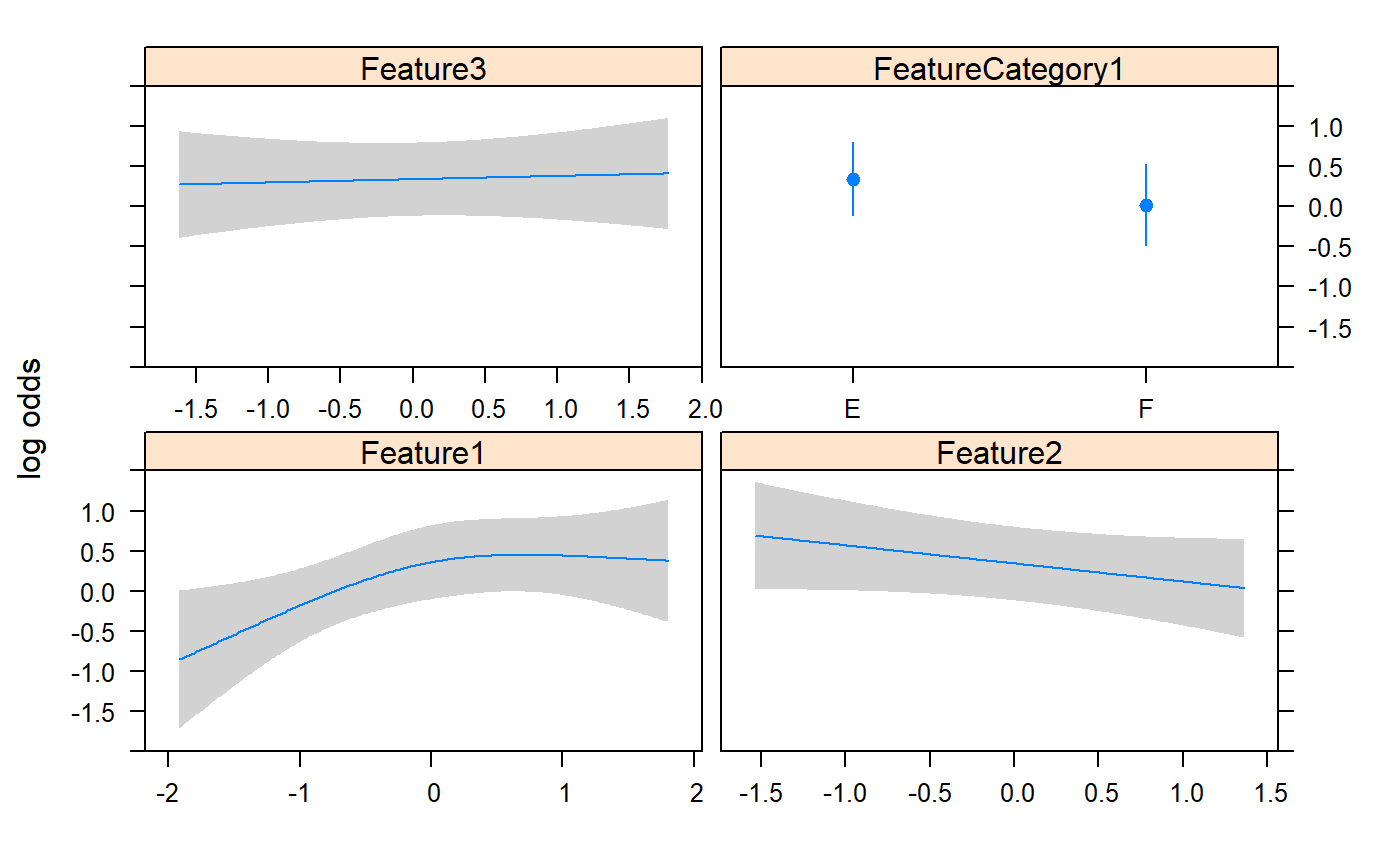
print(modelResult)Logistic Regression Model
lrm(formula = formulaForModel, data = rawData)
Model Likelihood Discrimination Rank Discrim.
Ratio Test Indexes Indexes
Obs 200 LR chi2 10.06 R2 0.065 C 0.600
0 100 d.f. 5 g 0.508 Dxy 0.199
1 100 Pr(> chi2) 0.0737 gr 1.662 gamma 0.199
max |deriv| 1e-12 gp 0.120 tau-a 0.100
Brier 0.238
Coef S.E. Wald Z Pr(>|Z|)
Intercept 0.5604 0.3297 1.70 0.0892
Feature1 0.7432 0.3274 2.27 0.0232
Feature1' -0.5401 0.3520 -1.53 0.1250
Feature2 -0.2257 0.1574 -1.43 0.1514
Feature3 0.0406 0.1512 0.27 0.7885
FeatureCategory1=F -0.3259 0.2952 -1.10 0.2696
#extract p value from results
#http://r.789695.n4.nabble.com/Extracting-P-values-from-the-lrm-function-in-the-rms-library-td2260999.html
pnorm(abs(modelResult$coef/sqrt(diag(modelResult$var))),lower.tail=F)*2
Intercept Feature1 Feature1' Feature2 Feature3 FeatureCategory1=F
0.08917042 0.02318681 0.12499723 0.15142348 0.78853165 0.26959283 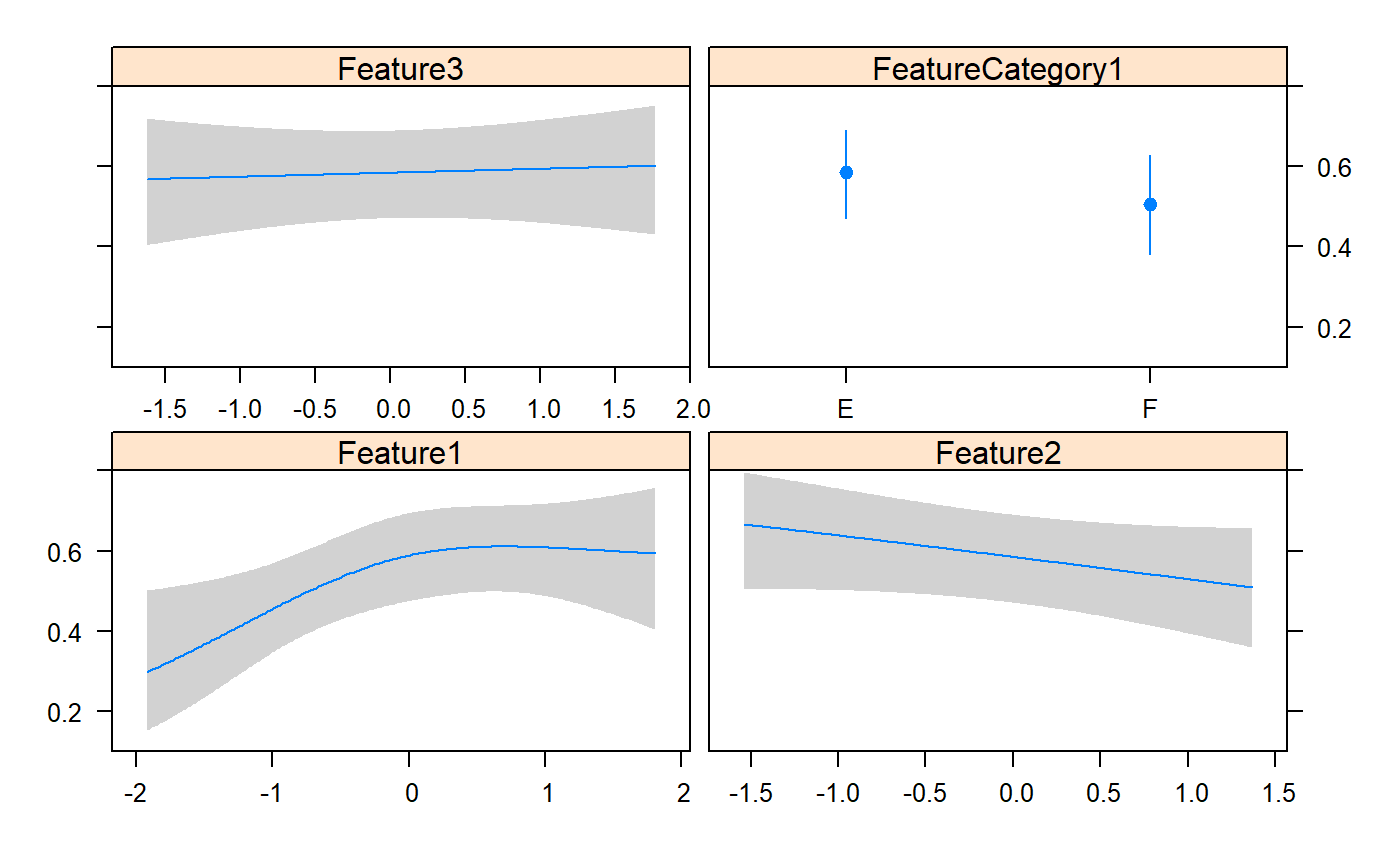
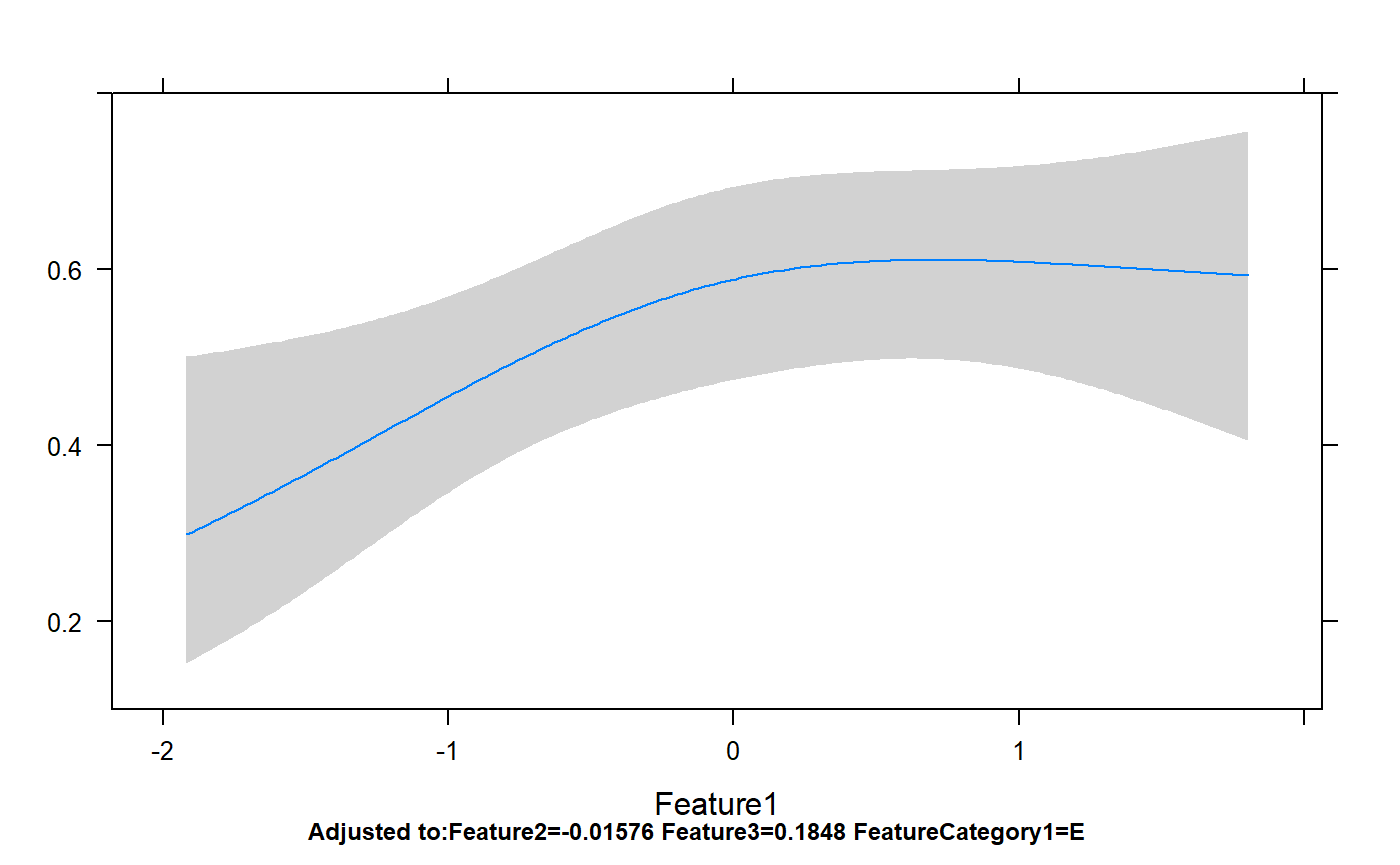
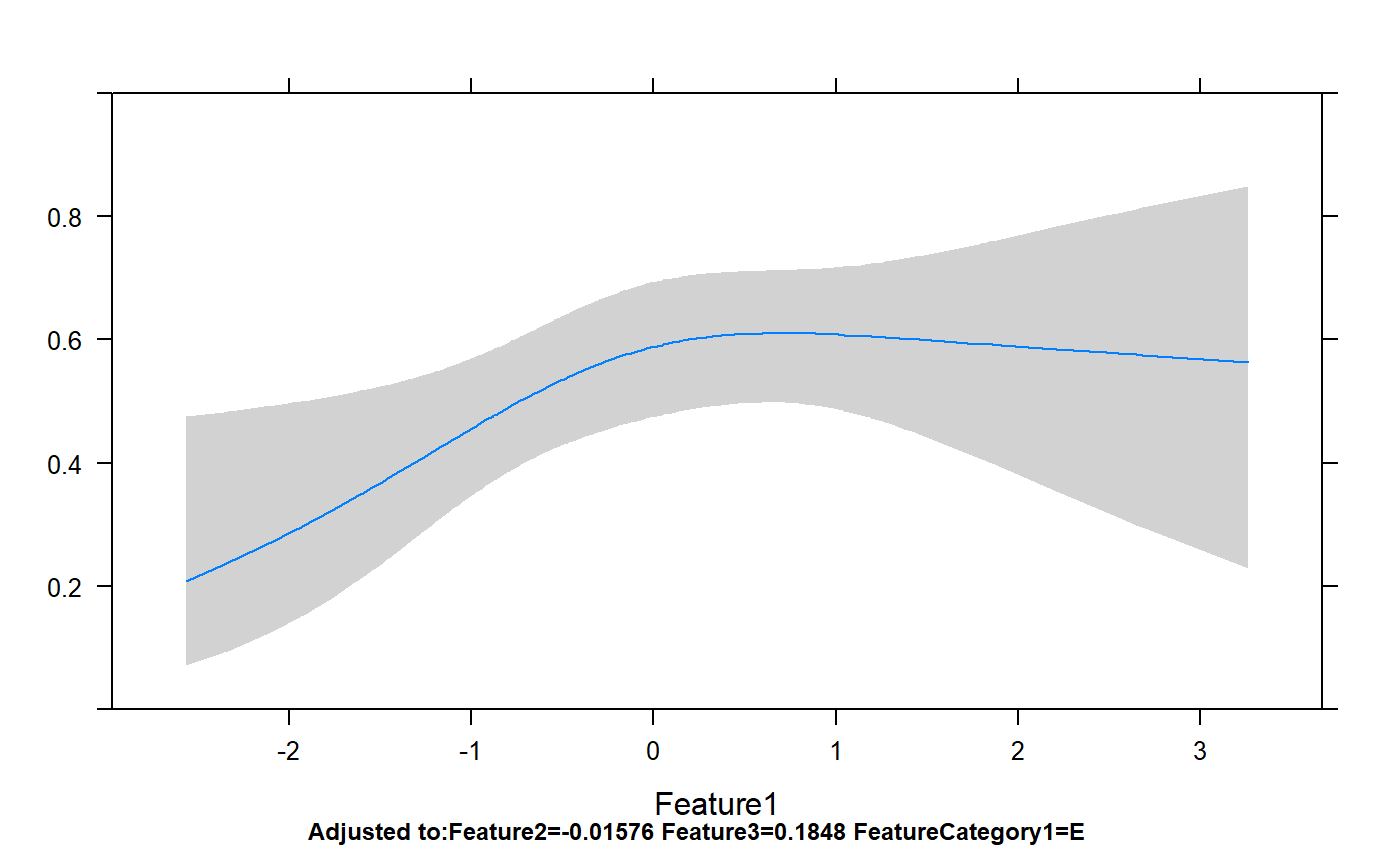
Classes 'Predict' and 'data.frame': 200 obs. of  7 variables:
 $ Feature1        : num  -2.56 -2.36 -2.35 -2.33 -2.28 ...
 $ Feature2        : num  -0.0158 -0.0158 -0.0158 -0.0158 -0.0158 ...
 $ Feature3        : num  0.185 0.185 0.185 0.185 0.185 ...
 $ FeatureCategory1: Factor w/ 2 levels "E","F": 1 1 1 1 1 1 1 1 1 1 ...
 $ yhat            : num  0.209 0.235 0.236 0.238 0.245 ...
 $ lower           : num  0.0714 0.092 0.0932 0.0947 0.1004 ...
 $ upper           : num  0.475 0.482 0.483 0.483 0.485 ...
 - attr(*, "out.attrs")=List of 2
  ..$ dim     : Named int  200 1 1 1
  .. ..- attr(*, "names")= chr  "Feature1" "Feature2" "Feature3" "FeatureCategory1"
  ..$ dimnames:List of 4
  .. ..$ Feature1        : chr  "Feature1=-2.562726" "Feature1=-2.356756" "Feature1=-2.345888" "Feature1=-2.332444" ...
  .. ..$ Feature2        : chr "Feature2=-0.01576"
  .. ..$ Feature3        : chr "Feature3=0.1848"
  .. ..$ FeatureCategory1: chr "FeatureCategory1=E"
 - attr(*, "info")=List of 11
  ..$ varying     : chr "Feature1"
  ..$ adjust      : chr "Feature2=-0.01576 Feature3=0.1848 FeatureCategory1=E "
  ..$ Design      :List of 3
  .. ..$ label      : Named chr  "Feature1" "Feature2" "Feature3" "FeatureCategory1"
  .. .. ..- attr(*, "names")= chr  "Feature1" "Feature2" "Feature3" "FeatureCategory1"
  .. ..$ units      : Named chr  "" "" "" ""
  .. .. ..- attr(*, "names")= chr  "Feature1" "Feature2" "Feature3" "FeatureCategory1"
  .. ..$ assume.code: Named int  4 1 1 5
  .. .. ..- attr(*, "names")= chr  "Feature1" "Feature2" "Feature3" "FeatureCategory1"
  ..$ ylabPlotmath: chr ""
  ..$ ylabhtml    : chr ""
  ..$ ylab        : chr ""
  ..$ yunits      : NULL
  ..$ ref.zero    : logi FALSE
  ..$ adj.zero    : logi FALSE
  ..$ time        : NULL
..$ conf.int : num 0.95p=rms:::ggplot.Predict(temp,ylim=c(0,1))
#same thing
#p=ggplot(temp,aes(x=Feature1,y=yhat),ylim=c(0,1))+geom_line()+geom_ribbon(aes(ymin=lower,ymax=upper),alpha=0.05)
p+geom_point(aes(x=Feature1,y=FeatureYN1),data=dataForModel)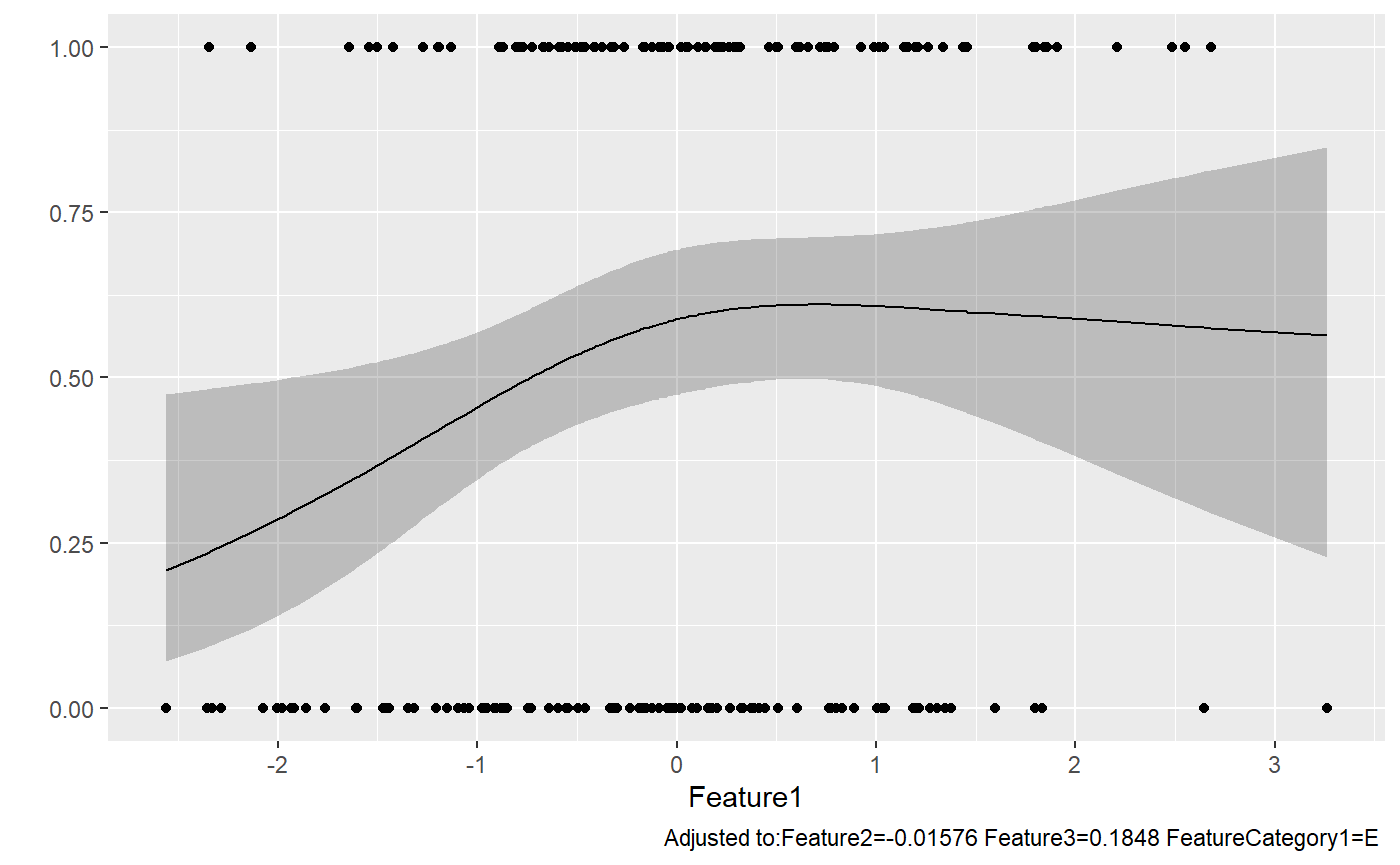
##Logistic regression: ROC curve and best cutoff
Simple one variable model
https://stackoverflow.com/questions/16347507/obtaining-threshold-values-from-a-roc-curve
Or using OptimalCutpoints package which provides many algorithms to find an optimal thresholds. Or coords function in pROC package
source("D:\\source\\r_cqs\\myPkg\\R\\logisticRegressionAndRocFunctions.R")

dataForModel=rawData
temp=makeModelAndTable(dataForModel,labelVar="FeatureYN1",xVar="Feature1")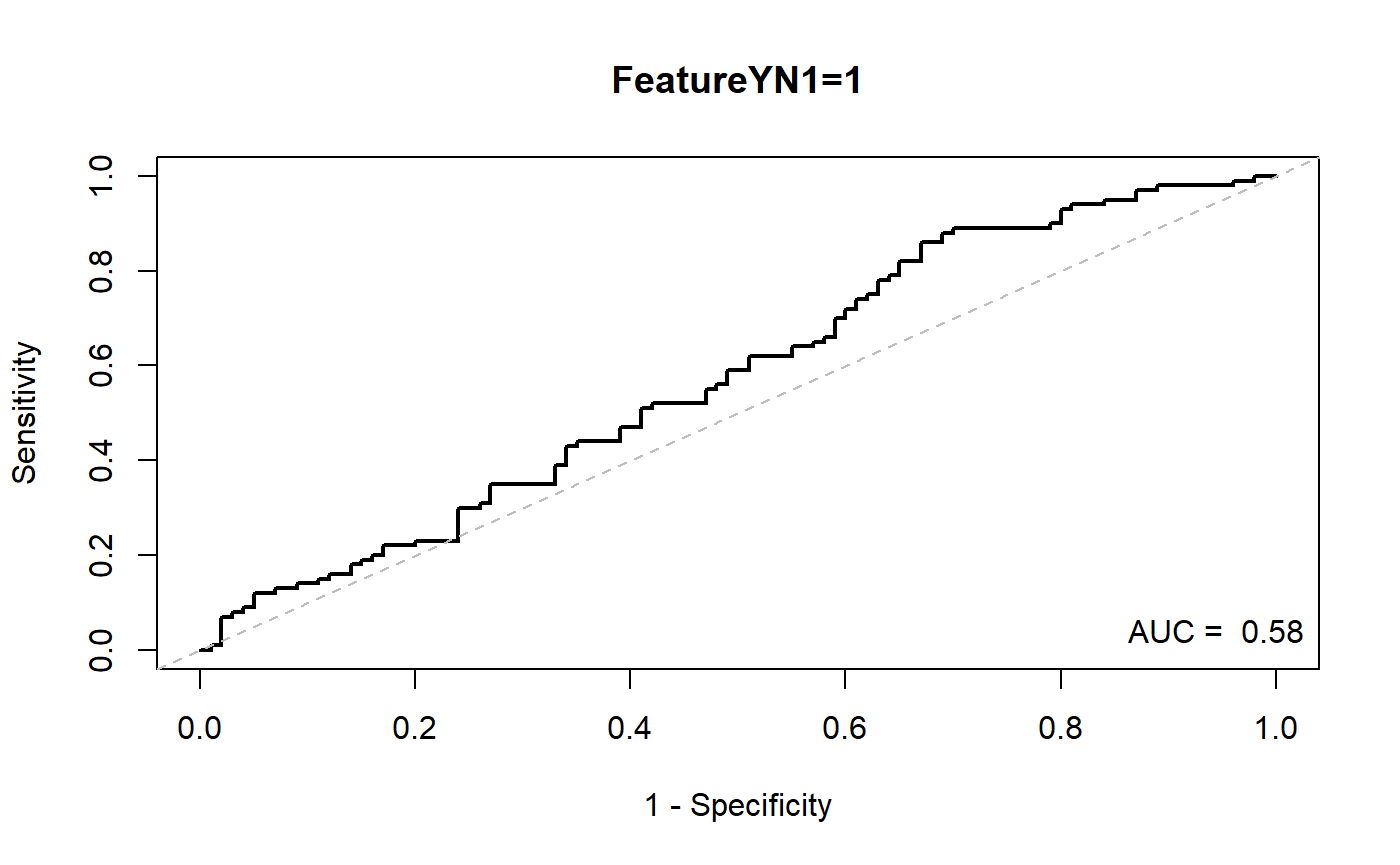
| cut | sens | spec | ppv | npv |
|---|---|---|---|---|
| -1.44327239102318 | 0.95 | 0.15 | 0.5300000 | 0.7500000 |
| -0.771357770606852 | 0.83 | 0.33 | 0.5500000 | 0.6600000 |
| -0.0396971579882457 | 0.53 | 0.53 | 0.5300000 | 0.5300000 |
| 0.744156606775947 | 0.26 | 0.76 | 0.5200000 | 0.5100000 |
| 1.31169924528837 | 0.13 | 0.93 | 0.6500000 | 0.5200000 |
| Max (Sens+Spec): -0.803291122937887 | 0.86 | 0.33 | 0.5620915 | 0.7021277 |
| Max Spec when Sens>=0.8: -0.667217415388882 | 0.80 | 0.35 | 0.5517241 | 0.6363636 |
Complicated Model
source("D:\\source\\r_cqs\\myPkg\\R\\logisticRegressionAndRocFunctions.R")

otherVar=c("FeatureYN1")
xVarList<-list(
        "Feature1",
        c("Feature2","FeatureCategory1")
)
otherVar=c("Feature3") #like age and gender
plotModelRocAdjusted(dataForModel,
        xVarList=xVarList,outVar=outVar,otherVar=otherVar,
        verbose=TRUE)
## Logistic Regression Model
##
## lrm(formula = formulaForModel, data = dataForModel, x = TRUE,
## y = TRUE)
##
## Model Likelihood Discrimination Rank Discrim.
## Ratio Test Indexes Indexes
## Obs 200 LR chi2 4.45 R2 0.029 C 0.582
## 0 100 d.f. 2 g 0.343 Dxy 0.163
## 1 100 Pr(> chi2) 0.1083 gr 1.409 gamma 0.163
## max |deriv| 1e-09 gp 0.084 tau-a 0.082
## Brier 0.244
##
## Coef S.E. Wald Z Pr(>|Z|)
## Intercept 0.0064 0.1439 0.04 0.9647
## Feature1 0.2769 0.1342 2.06 0.0391
## Feature3 0.0257 0.1491 0.17 0.8632
## ## Setting levels: control = 0, case = 1## Setting direction: controls < cases## Logistic Regression Model
##
## lrm(formula = formulaForModel, data = dataForModel, x = TRUE,
## y = TRUE)
##
## Model Likelihood Discrimination Rank Discrim.
## Ratio Test Indexes Indexes
## Obs 200 LR chi2 2.67 R2 0.018 C 0.555
## 0 100 d.f. 3 g 0.264 Dxy 0.109
## 1 100 Pr(> chi2) 0.4453 gr 1.303 gamma 0.109
## max |deriv| 2e-11 gp 0.065 tau-a 0.055
## Brier 0.247
##
## Coef S.E. Wald Z Pr(>|Z|)
## Intercept 0.1075 0.1923 0.56 0.5763
## Feature2 -0.2120 0.1553 -1.37 0.1722
## FeatureCategory1=F -0.2653 0.2868 -0.93 0.3549
## Feature3 0.0247 0.1487 0.17 0.8681
## ## Setting levels: control = 0, case = 1
## Setting direction: controls < cases## Logistic Regression Model
##
## lrm(formula = formulaForModel, data = dataForModel, x = TRUE,
## y = TRUE)
##
## Model Likelihood Discrimination Rank Discrim.
## Ratio Test Indexes Indexes
## Obs 200 LR chi2 7.65 R2 0.050 C 0.599
## 0 100 d.f. 4 g 0.453 Dxy 0.198
## 1 100 Pr(> chi2) 0.1052 gr 1.573 gamma 0.198
## max |deriv| 8e-08 gp 0.109 tau-a 0.099
## Brier 0.241
##
## Coef S.E. Wald Z Pr(>|Z|)
## Intercept 0.1552 0.1961 0.79 0.4288
## Feature1 0.3006 0.1376 2.19 0.0289
## Feature2 -0.2181 0.1568 -1.39 0.1643
## FeatureCategory1=F -0.3481 0.2935 -1.19 0.2357
## Feature3 0.0181 0.1501 0.12 0.9039
## ## Setting levels: control = 0, case = 1
## Setting direction: controls < cases## Warning in coords.roc(resultRoc[[length(resultRoc)]], "best"): An upcoming version of pROC will set the 'transpose' argument to FALSE by default. Set transpose = TRUE explicitly to keep the current behavior, or transpose = FALSE to adopt the new one and silence this warning. Type help(coords_transpose) for additional information.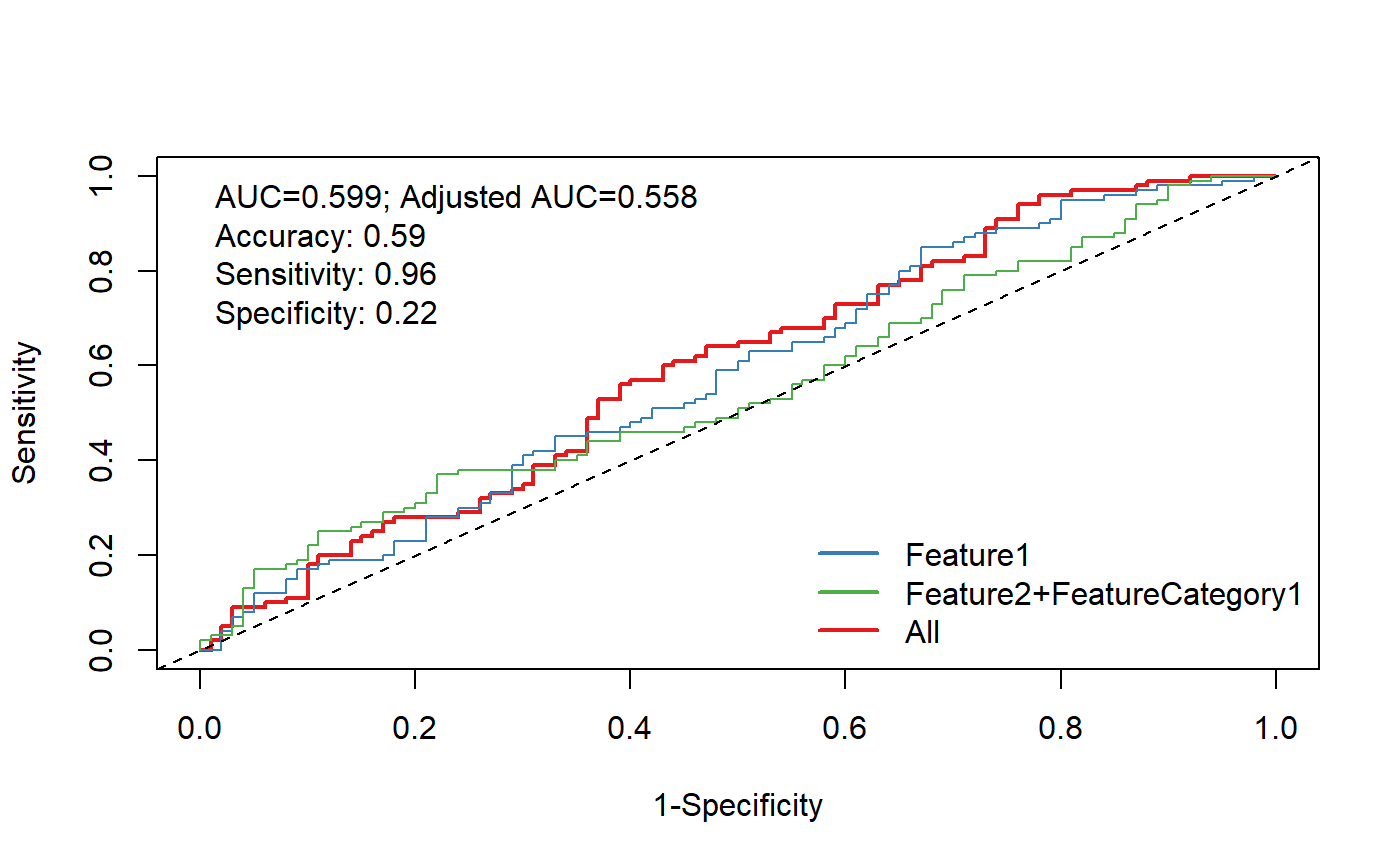
## Confusion Matrix and Statistics
##
##           Reference
## Prediction  0  1
##          0 22  4
##          1 78 96
##
##                Accuracy : 0.59
##                  95% CI : (0.5184, 0.6589)
##     No Information Rate : 0.5
##     P-Value [Acc > NIR] : 0.006565
##
##                   Kappa : 0.18
##
##  Mcnemar's Test P-Value : 7.536e-16
##
##             Sensitivity : 0.9600
##             Specificity : 0.2200
##          Pos Pred Value : 0.5517
##          Neg Pred Value : 0.8462
##              Prevalence : 0.5000
##          Detection Rate : 0.4800
##    Detection Prevalence : 0.8700
##       Balanced Accuracy : 0.5900
##
##        'Positive' Class : 1
##
Linear regression
outVar="Feature1"
varForTable=c("FeatureYN1", "Feature2","Feature3","FeatureCategory1")

nonLinearTest(rawData,outVar,varForTable,modelType ="ols")
Outcome X Formula P (Variable) P ( Nonlinear) P (TOTAL)
[1,] "Feature1" "Feature2" "Feature1 ~ rcs(Feature2, 3)" "0.961" "0.868" "0.961"
[2,] "Feature1" "Feature3" "Feature1 ~ rcs(Feature3, 3)" "0.106" "0.035" "0.106" modelTable(rawData,outVars="Feature1",interestedVars=list(c("FeatureYN1"),c("Feature2","FeatureCategory1")),adjVars="Feature3",modelType ="ols") Formula InterestedVar P Effect (One Unit) Effect (Lower 95%) Effect (Upper 95%) Value (25% Quantile) Value (75% Quantile) Value Diff (75%-25%) Effect (Diff: 75%-25%) Effect (Diff, Lower 95%) Effect (Diff, Upper 95%)
1 ols (Feature1 ~ FeatureYN1 + Feature3) FeatureYN1 - 1:0 0.076 0.239 -0.027 0.505
2 ols (Feature1 ~ Feature2 + FeatureCategory1 + Feature3) Feature2 0.6897 -0.028 -0.169 0.112 -0.555 0.685 1.24 -0.035 -0.209 0.139
3 ols (Feature1 ~ Feature2 + FeatureCategory1 + Feature3) FeatureCategory1 - F:E 0.0696 -0.244 -0.509 0.021 modelTable(rawData,outVars="Feature1",interestedVars=c("FeatureYN1","Feature2","FeatureCategory1"),adjVars="Feature3",modelType ="ols") Formula InterestedVar P Effect (One Unit) Effect (Lower 95%) Effect (Upper 95%) Value (25% Quantile) Value (75% Quantile) Value Diff (75%-25%) Effect (Diff: 75%-25%) Effect (Diff, Lower 95%) Effect (Diff, Upper 95%)
1 ols (Feature1 ~ FeatureYN1 + Feature3) FeatureYN1 - 1:0 0.076 0.239 -0.027 0.505
2 ols (Feature1 ~ Feature2 + Feature3) Feature2 0.8021 -0.018 -0.159 0.123 -0.555 0.685 1.24 -0.022 -0.197 0.152
3 ols (Feature1 ~ FeatureCategory1 + Feature3) FeatureCategory1 - F:E 0.0732 -0.240 -0.503 0.024 Survival Model
KM Curves
source("D:\\source\\r_cqs\\myPkg\\R\\survivalCurveTable.R")

set.seed(123)
rawData$FeatureAbs1<-abs(rnorm(nrow(rawData))*100)

fit1 <- survfit(Surv(FeatureAbs1, FeatureYN1) ~ FeatureCategory1,data=rawData)
kmplot(fit1,col.surv=1:2,lwd.surv=3,grid=FALSE,las=1,pValue=TRUE,cex.axis=1.2,loc.legend="topright")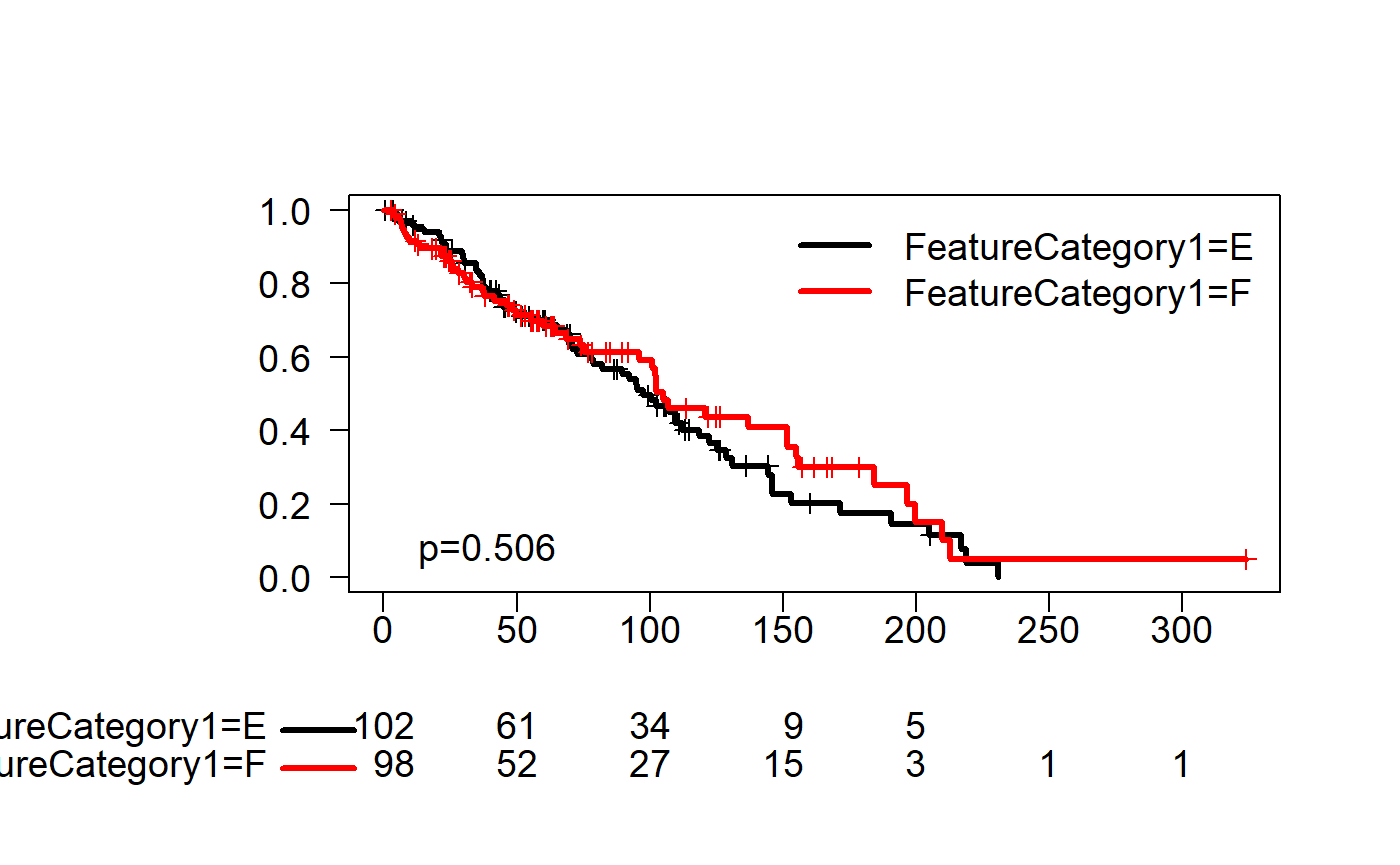
## Call: survfit(formula = Surv(FeatureAbs1, FeatureYN1) ~ FeatureCategory1,
##     data = rawData)
##
##                      n events median 0.95LCL 0.95UCL
## FeatureCategory1=E 102     64   97.7    78.0     122
## FeatureCategory1=F  98     49  104.9    96.2     155
Model
ddist <- datadist(rawData)
options(datadist='ddist')

varForSurvivalModel1=c("FeatureCategory1","Feature2")
(fmla<-as.formula(paste0("Surv(FeatureAbs1, FeatureYN1)~",paste0(varForSurvivalModel1,collapse="+"))))
## Surv(FeatureAbs1, FeatureYN1) ~ FeatureCategory1 + Feature2## Cox Proportional Hazards Model
##
## cph(formula = fmla, data = rawData, x = TRUE, y = TRUE)
##
## Model Tests Discrimination
## Indexes
## Obs 200 LR chi2 5.05 R2 0.025
## Events 113 d.f. 2 Dxy 0.063
## Center -0.0066 Pr(> chi2) 0.0799 g 0.259
## Score chi2 4.89 gr 1.296
## Pr(> chi2) 0.0867
##
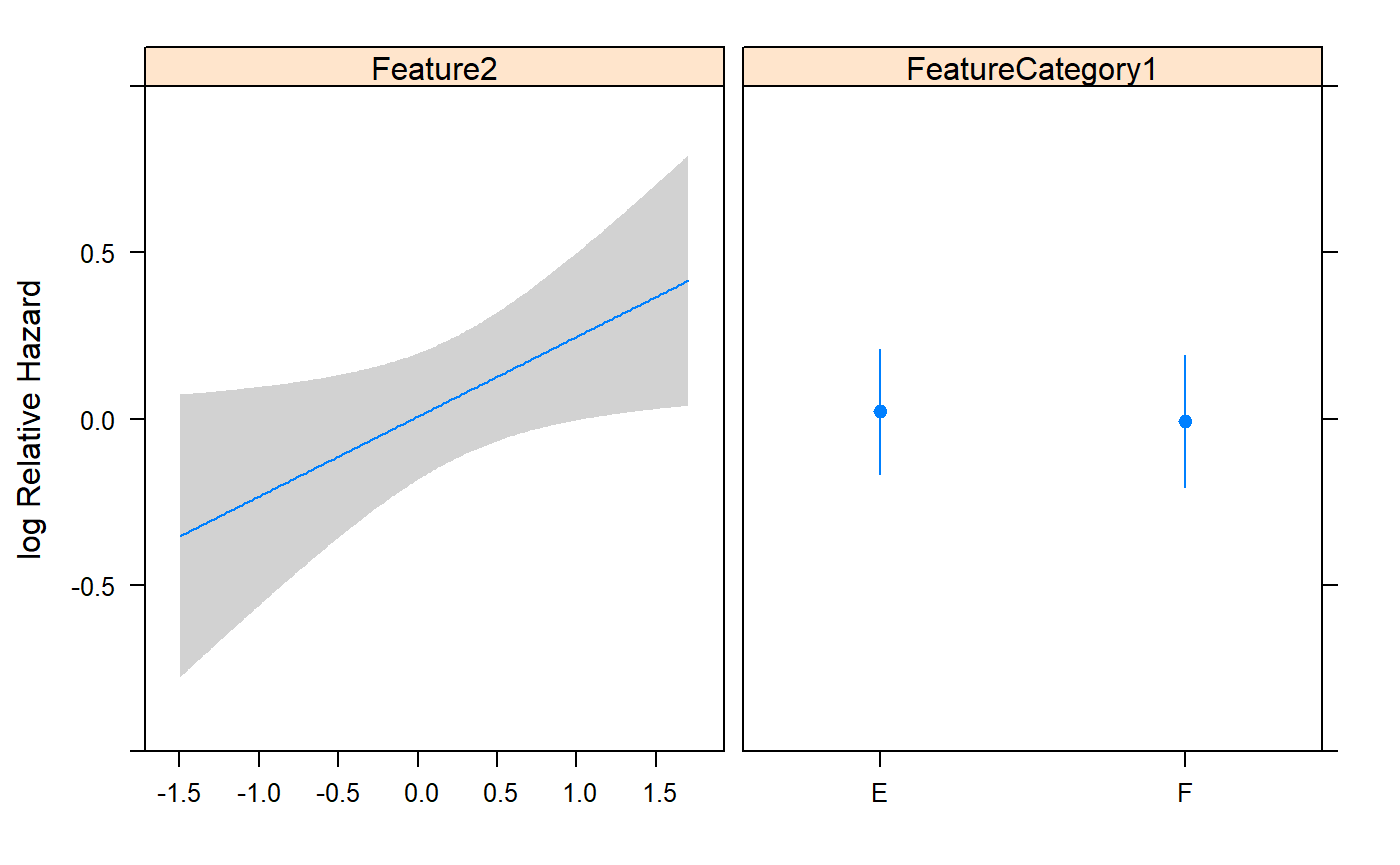
## Coef S.E. Wald Z Pr(>|Z|)
## FeatureCategory1=F -0.0285 0.1964 -0.14 0.8847
## Feature2 0.2400 0.1135 2.11 0.0345
## 
##       index.orig training   test optimism index.corrected  n
## Dxy       0.0630   0.1050 0.0614   0.0437          0.0193 40
## R2        0.0252   0.0382 0.0213   0.0169          0.0082 40
## Slope     1.0000   1.0000 0.7995   0.2005          0.7995 40
## D         0.0042   0.0071 0.0034   0.0037          0.0005 40
## U        -0.0021  -0.0021 0.0013  -0.0034          0.0013 40
## Q         0.0063   0.0092 0.0021   0.0071         -0.0008 40
## g         0.2593   0.3122 0.2369   0.0753          0.1840 40
Concordance and C-index
testData=data.frame(FeatureYN1=c(0,1),FeatureAbs1=1:10,FeatureYN2=as.factor(rep(c(0,1),each=5)),FeatureAbs2=c(1,2,3,4,5),FeatureYN3=as.factor(c(0,1)),FeatureYN4=as.factor(c(0,0,0,1,0,1,0,1,0,1)))

ddist <- datadist(testData)
options(datadist='ddist')

varForSurvivalModel1=c("FeatureYN3")
(fmla<-as.formula(paste0("Surv(FeatureAbs1, FeatureYN1)~",paste0(varForSurvivalModel1,collapse="+"))))
## Surv(FeatureAbs1, FeatureYN1) ~ FeatureYN3## Cox Proportional Hazards Model
##
## cph(formula = fmla, data = testData)
##
## Model Tests Discrimination
## Indexes
## Obs 10 LR chi2 4.13 R2 0.453
## Events 5 d.f. 1 Dxy 0.500
## Center 4.9389 Pr(> chi2) 0.0422 g 5.488
## Score chi2 2.70 gr 241.682
## Pr(> chi2) 0.1001
##
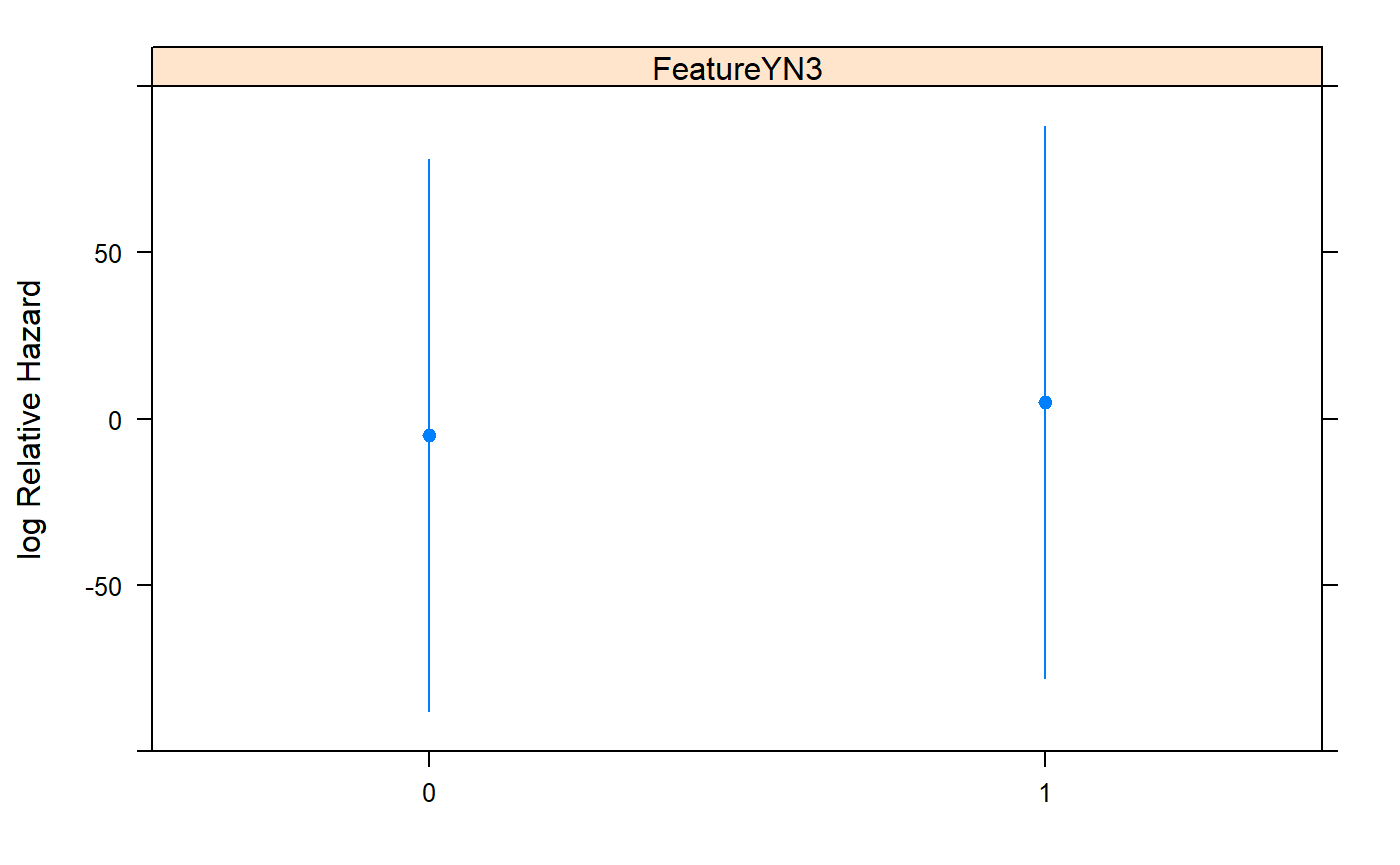
## Coef S.E. Wald Z Pr(>|Z|)
## FeatureYN3=1 9.8777 84.7068 0.12 0.9072
## 
#Dxy are equal to 2 * (C - 0.5), so C-index=(Dxy+1)/2=0.75

rcorr.cens(testData$FeatureAbs2, Surv(testData$FeatureAbs1, testData$FeatureYN1)) #0.75
## C Index Dxy S.D. n missing uncensored Relevant Pairs Concordant Uncertain
## 0.7500000 0.5000000 0.2397916 10.0000000 0.0000000 5.0000000 40.0000000 30.0000000 50.0000000## Warning in fitter(X, Y, istrat, offset, init, control, weights = weights, : Loglik converged before variable 1 ; coefficient may be infinite.## Call:
## concordance.coxph(object = fit1)
##
## n= 10
## Concordance= 0.75 se= 0.09682
## concordant discordant tied.x tied.y tied.xy
## 10 0 10 0 0## Loading required package: prodlim## Warning: package 'prodlim' was built under R version 3.6.1concordance.index(x=testData$FeatureAbs2, surv.time=testData$FeatureAbs1, surv.event=testData$FeatureYN1,outx=FALSE) #0.25, if using x=-testData$FeatureAbs2, getting 0.75## $c.index
## [1] 0.25
##
## $se
## [1] NA
##
## $lower
## [1] 0.02907911
##
## $upper
## [1] 0.7876805
##
## $p.value
## [1] NA
##
## $n
## [1] 10
##
## $data
## $data$x
## [1] 1 2 3 4 5 1 2 3 4 5
##
## $data$surv.time
## [1] 1 2 3 4 5 6 7 8 9 10
##
## $data$surv.event
## [1] 0 1 0 1 0 1 0 1 0 1
##
##
## $comppairs
## [1] 40concordance.index(x=testData$FeatureYN3, surv.time=testData$FeatureAbs1,surv.event=testData$FeatureYN1,outx=TRUE)## $c.index
## [1] NA
##
## $se
## [1] NA
##
## $lower
## [1] NA
##
## $upper
## [1] NA
##
## $p.value
## [1] NA
##
## $n
## [1] 10
##
## $data
## $data$x
## [1] 0 1 0 1 0 1 0 1 0 1
## Levels: 0 1
##
## $data$surv.time
## [1] 1 2 3 4 5 6 7 8 9 10
##
## $data$surv.event
## [1] 0 1 0 1 0 1 0 1 0 1
##
##
## $comppairs
## [1] 20concordance.index(x=testData$FeatureYN4, surv.time=testData$FeatureAbs1,surv.event=testData$FeatureYN1,outx=TRUE)## $c.index
## [1] 0.6
##
## $se
## [1] NA
##
## $lower
## [1] 0.08406052
##
## $upper
## [1] 0.9608096
##
## $p.value
## [1] NA
##
## $n
## [1] 10
##
## $data
## $data$x
## [1] 0 0 0 1 0 1 0 1 0 1
## Levels: 0 1
##
## $data$surv.time
## [1] 1 2 3 4 5 6 7 8 9 10
##
## $data$surv.event
## [1] 0 1 0 1 0 1 0 1 0 1
##
##
## $comppairs
## [1] 20##Missing values
Table 0: Missing Data Describe
varForTable=colnames(rawDataWithMissing)
s=describe(rawDataWithMissing[,varForTable])
html(s, exclude1=FALSE,  what=c('%'),digits=3, prmsd=TRUE)
## Warning in png(file, width = 1 + k * w, height = h): 'width=13, height=13' are unlikely values in pixelsrawDataWithMissing[, varForTable]
13 Variables 200 Observations
13 Variables 200 Observations
Feature1

        n  missing distinct     Info     Mean      Gmd      .05      .10      .25
      191        9      191        1  0.04745    1.075  -1.7758  -1.3315  -0.4751
      .50      .75      .90      .95
   0.1021   0.7174   1.2184   1.5383
| lowest : | -2.639306 | -2.527274 | -2.304690 | -2.024790 | -1.972192 |
| highest: | 1.827012 | 1.907589 | 1.978721 | 2.159180 | 2.345727 |
Feature2

        n  missing distinct     Info     Mean      Gmd      .05      .10      .25
      190       10      190        1  0.04649    1.048 -1.44808 -1.13547 -0.52462
      .50      .75      .90      .95
  0.07378  0.66921  1.27675  1.69768
| lowest : | -2.777412 | -2.508263 | -2.074123 | -1.986896 | -1.979580 |
| highest: | 1.796271 | 1.831323 | 1.849473 | 2.163419 | 2.348937 |
Feature3

         n   missing  distinct      Info      Mean       Gmd       .05       .10
       185        15       185         1   0.03192     1.156 -1.764851 -1.191339
       .25       .50       .75       .90       .95
 -0.597037  0.002022  0.731282  1.457951  1.679656
| lowest : | -2.725607 | -2.264711 | -2.207013 | -2.188020 | -2.173589 |
| highest: | 2.052789 | 2.102634 | 2.126548 | 2.136332 | 2.310895 |
Feature4

        n  missing distinct     Info     Mean      Gmd      .05      .10      .25
      185       15      185        1   0.1263    1.148  -1.4523  -1.1570  -0.5940
      .50      .75      .90      .95
   0.1226   0.8695   1.3664   1.8094
| lowest : | -2.692560 | -2.244344 | -1.924571 | -1.883894 | -1.804621 |
| highest: | 2.248268 | 2.309956 | 2.320966 | 2.602364 | 2.641158 |
Feature5

        n  missing distinct     Info     Mean      Gmd      .05      .10      .25
      185       15      185        1 -0.07152    1.154  -1.6226  -1.3590  -0.8384
      .50      .75      .90      .95
  -0.1233   0.6871   1.2558   1.7241
| lowest : | -2.640512 | -2.345108 | -2.198916 | -1.952043 | -1.909586 |
| highest: | 1.994208 | 2.115217 | 2.148598 | 2.335518 | 2.350423 |
Feature6

        n  missing distinct     Info     Mean      Gmd      .05      .10      .25
      182       18      182        1  0.05637    1.131 -1.67913 -1.18108 -0.68707
      .50      .75      .90      .95
  0.06727  0.74970  1.30356  1.69913
| lowest : | -2.360067 | -2.320204 | -2.044873 | -1.888736 | -1.881225 |
| highest: | 1.913851 | 1.933405 | 2.063325 | 2.241895 | 2.787574 |
Feature7

        n  missing distinct     Info     Mean      Gmd      .05      .10      .25
      182       18      182        1   0.1384      1.1  -1.5849  -1.1785  -0.5250
      .50      .75      .90      .95
   0.2155   0.8354   1.2754   1.4682
| lowest : | -2.421316 | -2.415046 | -2.146252 | -2.117070 | -1.741206 |
| highest: | 1.986423 | 2.105750 | 2.207151 | 2.557260 | 2.619695 |
Feature8

         n   missing  distinct      Info      Mean       Gmd       .05       .10
       184        16       184         1 -0.006987     1.038 -1.575089 -1.134838
       .25       .50       .75       .90       .95
 -0.611357 -0.005552  0.628806  1.146343  1.375269
| lowest : | -2.749489 | -2.571196 | -2.326160 | -2.192145 | -2.103843 |
| highest: | 1.785670 | 1.897934 | 2.017092 | 2.132327 | 3.075039 |
Feature9

        n  missing distinct     Info     Mean      Gmd      .05      .10      .25
      180       20      180        1  0.07332    1.223 -1.85282 -1.22584 -0.67268
      .50      .75      .90      .95
  0.07349  0.71873  1.28070  2.08699
| lowest : | -3.161448 | -2.641805 | -2.512105 | -2.327999 | -2.233521 |
| highest: | 2.520853 | 2.527255 | 2.643755 | 2.895626 | 2.896421 |
Feature10

        n  missing distinct     Info     Mean      Gmd      .05      .10      .25
      184       16      184        1 -0.07797    1.133 -1.85996 -1.48696 -0.70670
      .50      .75      .90      .95
 -0.01601  0.59932  1.18404  1.62936
| lowest : | -2.477123 | -2.403935 | -2.272974 | -2.261448 | -2.046365 |
| highest: | 1.845156 | 1.890087 | 1.897335 | 1.919223 | 2.546919 |
FeatureYN1
| n | missing | distinct | Info | Sum | Mean | Gmd |
|---|---|---|---|---|---|---|
| 185 | 15 | 2 | 0.74 | 103 | 0.5568 | 0.4962 |
FeatureCategory1
| n | missing | distinct |
|---|---|---|
| 188 | 12 | 2 |
 Value          E     F
 Frequency     98    90
 Proportion 0.521 0.479
FeatureCategory2

| n | missing | distinct |
|---|---|---|
| 185 | 15 | 4 |
 Value          A     B     C     D
 Frequency     48    54    53    30
 Proportion 0.259 0.292 0.286 0.162
Missing Value Imputation
dataImputated <- aregImpute(~Feature1+Feature2+Feature3+
                Feature4+Feature5+Feature6+Feature7+Feature8+Feature9+Feature10+
                FeatureYN1+FeatureCategory1+FeatureCategory2,
        n.impute=10, data=rawDataWithMissing, nk=0,x=TRUE)
## Iteration 1
Iteration 2
Iteration 3
Iteration 4
Iteration 5
Iteration 6
Iteration 7
Iteration 8
Iteration 9
Iteration 10
Iteration 11
Iteration 12
Iteration 13 ##
## Multiple Imputation using Bootstrap and PMM
##
## aregImpute(formula = ~Feature1 + Feature2 + Feature3 + Feature4 +
## Feature5 + Feature6 + Feature7 + Feature8 + Feature9 + Feature10 +
## FeatureYN1 + FeatureCategory1 + FeatureCategory2, data = rawDataWithMissing,
## n.impute = 10, nk = 0, x = TRUE)
##
## n: 200 p: 13 Imputations: 10 nk: 0
##
## Number of NAs:
## Feature1 Feature2 Feature3 Feature4 Feature5 Feature6 Feature7 Feature8 Feature9 Feature10 FeatureYN1 FeatureCategory1 FeatureCategory2
## 9 10 15 15 15 18 18 16 20 16 15 12 15
##
## type d.f.
## Feature1 l 1
## Feature2 l 1
## Feature3 l 1
## Feature4 l 1
## Feature5 l 1
## Feature6 l 1
## Feature7 l 1
## Feature8 l 1
## Feature9 l 1
## Feature10 l 1
## FeatureYN1 l 1
## FeatureCategory1 c 1
## FeatureCategory2 c 3
##
## Transformation of Target Variables Forced to be Linear
##
## R-squares for Predicting Non-Missing Values for Each Variable
## Using Last Imputations of Predictors
## Feature1 Feature2 Feature3 Feature4 Feature5 Feature6 Feature7 Feature8 Feature9 Feature10 FeatureYN1 FeatureCategory1 FeatureCategory2
## 0.146 0.087 0.131 0.165 0.138 0.115 0.091 0.187 0.183 0.108 0.119 0.112 0.191## [1] "Feature1" "Feature2" "Feature3" "Feature4" "Feature5" "Feature6" "Feature7" "Feature8" "Feature9" "Feature10" "FeatureYN1" "FeatureCategory1" "FeatureCategory2"## [,1] [,2] [,3] [,4] [,5] [,6] [,7] [,8] [,9] [,10]
## Sample163 -1.9252795 0.07161431 1.530290893 -2.3046903 -1.8625206 -0.5475122 -1.3314980 -0.12369319 -0.06305878 -0.44084254
## Sample170 0.5343689 -1.63741841 0.175195465 -0.2965603 -0.4217670 -0.1800521 -0.9919236 0.02631987 0.07871215 -1.94313607
## Sample176 0.8092622 -0.47498252 -0.007745175 1.5373611 0.6679670 -0.1323495 0.3669057 0.84124489 -0.09101177 0.42978724
## Sample179 -0.6881552 -0.78933020 0.260467527 0.6679670 1.7061845 0.1296105 0.6679670 1.53029089 1.70618451 1.70618451
## Sample194 -0.4107861 -0.03540051 -0.273904423 -0.4107861 0.7228018 0.4028824 -1.5930815 0.23486904 0.40288242 0.02631987
## Sample199 0.8980107 0.20889323 0.802823332 -0.4107861 1.0767401 0.8028233 -0.5213969 -0.44388628 0.71201736 0.76203875Model after Missing Value Imputation
fmi <- fit.mult.impute(FeatureYN1~Feature1+Feature2+Feature3+FeatureCategory2,
        lrm, dataImputated,
#       subset=which(rawDataWithMissing$FeatureCategory1=="E"),
        data=rawDataWithMissing)
##
## Variance Inflation Factors Due to Imputation:
##
## Intercept Feature1 Feature2 Feature3 FeatureCategory2=B FeatureCategory2=C FeatureCategory2=D
## 1.07 1.22 1.12 1.39 1.11 1.11 1.23
##
## Rate of Missing Information:
##
## Intercept Feature1 Feature2 Feature3 FeatureCategory2=B FeatureCategory2=C FeatureCategory2=D
## 0.07 0.18 0.11 0.28 0.10 0.10 0.19
##
## d.f. for t-distribution for Tests of Single Coefficients:
##
## Intercept Feature1 Feature2 Feature3 FeatureCategory2=B FeatureCategory2=C FeatureCategory2=D
## 2092.07 280.19 735.03 114.01 897.40 868.80 259.75
##
## The following fit components were averaged over the 10 model fits:
##
## stats linear.predictors## Logistic Regression Model
##
## fit.mult.impute(formula = FeatureYN1 ~ Feature1 + Feature2 +
## Feature3 + FeatureCategory2, fitter = lrm, xtrans = dataImputated,
## data = rawDataWithMissing)
##
## Model Likelihood Discrimination Rank Discrim.
## Ratio Test Indexes Indexes
## Obs 200 LR chi2 8.47 R2 0.055 C 0.621
## 0 90 d.f. 6 g 0.481 Dxy 0.243
## 1 110 Pr(> chi2) 0.2334 gr 1.620 gamma 0.243
## max |deriv| 3e-08 gp 0.115 tau-a 0.120
## Brier 0.237
##
## Coef S.E. Wald Z Pr(>|Z|)
## Intercept 0.3104 0.2981 1.04 0.2978
## Feature1 0.2833 0.1707 1.66 0.0969
## Feature2 0.2428 0.1701 1.43 0.1535
## Feature3 -0.0304 0.1684 -0.18 0.8567
## FeatureCategory2=B 0.1170 0.4185 0.28 0.7799
## FeatureCategory2=C -0.3719 0.4167 -0.89 0.3722
## FeatureCategory2=D -0.2597 0.5091 -0.51 0.6100
## ##Some notes for Hmisc/rms package
library(scales)
ggplot(Predict(gls1))
print("Exp")

p<-ggplot(Predict(gls1),flipxdiscrete=FALSE,sepdiscrete="list",ylim(3,6))
p[[1]]
p[[1]]+scale_y_continuous(trans="exp",limits = c(3,6))

exp_format <- function() {
     function(x) format(exp(x),digits = 2)
}
p[[1]]+scale_y_continuous(trans="exp",limits = c(3,6),labels = exp_format())
p[[1]]+scale_y_continuous(labels = exp_format())


p[[2]]
p[[2]]+scale_x_continuous(trans="exp")


ggplot(Predict(gls1),flipxdiscrete=FALSE,addlayer=scale_y_continuous(trans="exp",labels=function(x) round(exp(x),2)))
ggplot(Predict(gls1),flipxdiscrete=FALSE)+coord_trans(y = "exp")
Two-Way ANOVA with Repeated Measures
https://biostats.w.uib.no/factorial-repeated-measures-anova-two-way-repeated-measures-anova/ http://psych.wisc.edu/moore/Rpdf/610-R9_Within2way.pdf https://datascienceplus.com/two-way-anova-with-repeated-measures/
rat.weight <- c(166,168,155,159,151,166,170,160,162,153,220,230,223,233,229,262,274,267,283,274,261,275,264,280,282,343,354,351,359,349,297,311,305,315,303,375,399,388,405,395)
rat.strain <- as.factor(rep(c(rep("strainA",5),rep("strainB",5)),4))
rat.ID <- as.factor(rep(c("rat01","rat02","rat03","rat04","rat05","rat06","rat07","rat08","rat09","rat10"),4))
time.point <- as.factor(c(rep("week08",10), rep("week12",10), rep("week16",10), rep("week20",10)))
my.dataframe <- data.frame(rat.ID,rat.strain,time.point,rat.weight)
head(my.dataframe)
## rat.ID rat.strain time.point rat.weight
## 1 rat01 strainA week08 166
## 2 rat02 strainA week08 168
## 3 rat03 strainA week08 155
## 4 rat04 strainA week08 159
## 5 rat05 strainA week08 151
## 6 rat06 strainB week08 166with(my.dataframe, interaction.plot(time.point, rat.ID, rat.weight, pch=c(rep(1,5), rep(2,5)), type="b", col=c("black", "red", "blue", "green", "purple", "orange", "grey", "darkblue", "pink", "darkred"), lty= c(1,2,3,4,5,6,7,8,9,10)))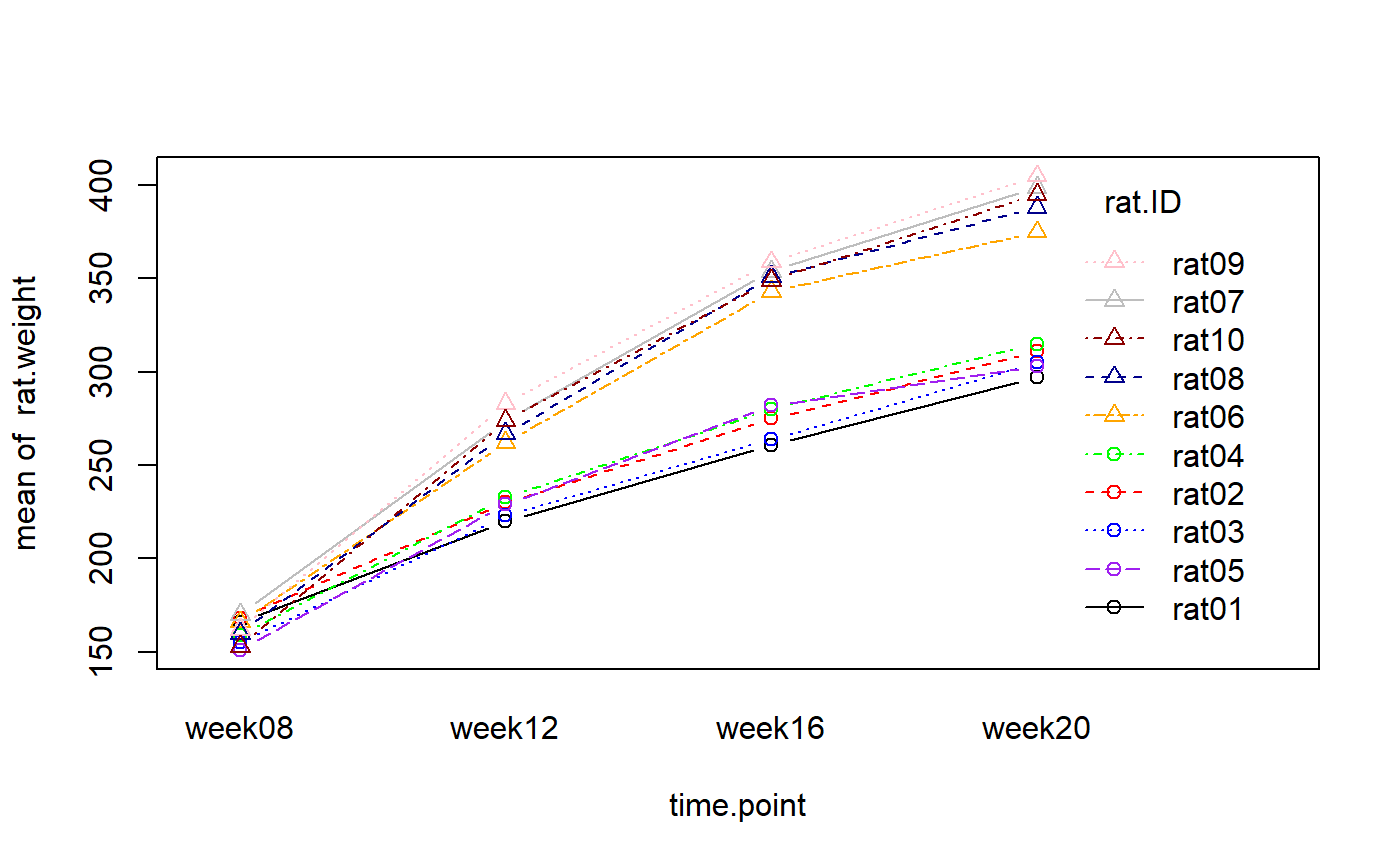
#we need to check for normality of distribution with the Shapiro-Wilk test:
shapiro.test(rat.weight[time.point=="week08" & rat.strain=="strainA"])
##
## Shapiro-Wilk normality test
##
## data: rat.weight[time.point == "week08" & rat.strain == "strainA"]
## W = 0.94153, p-value = 0.6768Two-Way ANOVA with Repeated Measures in dataset1
results <- aov(rat.weight~time.point*rat.strain + Error(rat.ID/time.point), data=my.dataframe)
summary(results)
##
## Error: rat.ID
## Df Sum Sq Mean Sq F value Pr(>F)
## rat.strain 1 28196 28196 217.5 4.39e-07 ***
## Residuals 8 1037 130
## ---
## Signif. codes: 0 '***' 0.001 '**' 0.01 '*' 0.05 '.' 0.1 ' ' 1
##
## Error: rat.ID:time.point
## Df Sum Sq Mean Sq F value Pr(>F)
## time.point 3 203193 67731 1750.5 < 2e-16 ***
## time.point:rat.strain 3 10980 3660 94.6 1.96e-13 ***
## Residuals 24 929 39
## ---
## Signif. codes: 0 '***' 0.001 '**' 0.01 '*' 0.05 '.' 0.1 ' ' 1A linear mixed-effects model with nested random effects. As a validation.
The F value is the same as Two-Way ANOVA above
library(nlme)

results.lme <- lme(rat.weight~time.point*rat.strain, random=~1|rat.ID, data=my.dataframe)
anova(results.lme)
## numDF denDF F-value p-value
## (Intercept) 1 24 22147.089 <.0001
## time.point 3 24 1750.535 <.0001
## rat.strain 1 8 217.521 <.0001
## time.point:rat.strain 3 24 94.598 <.0001Two-Way ANOVA with Repeated Measures in dataset2
set.seed(5250)

myData <- data.frame(PID = rep(seq(from = 1,
                               to = 50, by = 1), 20),
                     stress = sample(x = 1:100,
                                     size = 1000,
                                     replace = TRUE),
                     image = sample(c("Happy", "Angry"),
                                    size = 1000,
                                    replace = TRUE),
                     music = sample(c("Disney", "Horror"),
                                    size = 1000,
                                    replace = TRUE)
)

myData <- within(myData, {
  PID   <- factor(PID)
  image <- factor(image)
  music <- factor(music)
})

myData <- myData[order(myData$PID), ]
head(myData)
## PID stress image music
## 1 1 90 Angry Disney
## 51 1 42 Angry Disney
## 101 1 84 Angry Horror
## 151 1 10 Angry Horror
## 201 1 5 Angry Disney
## 251 1 34 Happy Disney#Extracting Condition Means
myData.mean <- aggregate(myData$stress,
by = list(myData$PID, myData$music,
myData$image),
FUN = 'mean')
colnames(myData.mean) <- c("PID","music","image","stress")
myData.mean <- myData.mean[order(myData.mean$PID), ]
head(myData.mean)## PID music image stress
## 1 1 Disney Angry 44.5
## 51 1 Horror Angry 51.5
## 100 1 Disney Happy 49.8
## 149 1 Horror Happy 51.6
## 2 2 Disney Angry 38.5
## 52 2 Horror Angry 28.2#Building the ANOVA
stress.aov1 <- with(myData.mean,
aov(stress ~ music * image +
Error(PID / (music * image)))
)## Warning in aov(stress ~ music * image + Error(PID/(music * image))): Error() model is singular##
## Error: PID
## Df Sum Sq Mean Sq F value Pr(>F)
## music 1 739 739.5 5.171 0.0276 *
## music:image 1 707 706.7 4.942 0.0311 *
## Residuals 47 6721 143.0
## ---
## Signif. codes: 0 '***' 0.001 '**' 0.01 '*' 0.05 '.' 0.1 ' ' 1
##
## Error: PID:music
## Df Sum Sq Mean Sq F value Pr(>F)
## music 1 13 12.6 0.060 0.808
## image 1 164 163.8 0.774 0.383
## music:image 1 295 295.1 1.395 0.244
## Residuals 47 9943 211.6
##
## Error: PID:image
## Df Sum Sq Mean Sq F value Pr(>F)
## image 1 20 20.18 0.109 0.743
## music:image 1 282 282.10 1.524 0.223
## Residuals 48 8884 185.08
##
## Error: PID:music:image
## Df Sum Sq Mean Sq F value Pr(>F)
## music:image 1 43 43.13 0.214 0.646
## Residuals 47 9457 201.21## Warning in aov(stress ~ music * image + Error(PID/(music * image))): Error() model is singular##
## Error: PID
## Df Sum Sq Mean Sq F value Pr(>F)
## music 1 33 33 0.056 0.81398
## image 1 777 777 1.312 0.25795
## music:image 1 5452 5452 9.211 0.00395 **
## Residuals 46 27229 592
## ---
## Signif. codes: 0 '***' 0.001 '**' 0.01 '*' 0.05 '.' 0.1 ' ' 1
##
## Error: PID:music
## Df Sum Sq Mean Sq F value Pr(>F)
## music 1 193 193 0.252 0.6177
## image 1 37 37 0.049 0.8262
## music:image 1 3622 3622 4.731 0.0347 *
## Residuals 47 35982 766
## ---
## Signif. codes: 0 '***' 0.001 '**' 0.01 '*' 0.05 '.' 0.1 ' ' 1
##
## Error: PID:image
## Df Sum Sq Mean Sq F value Pr(>F)
## image 1 297 297.0 0.396 0.532
## music:image 1 5 5.4 0.007 0.933
## Residuals 48 36038 750.8
##
## Error: PID:music:image
## Df Sum Sq Mean Sq F value Pr(>F)
## music:image 1 179 179.1 0.208 0.651
## Residuals 47 40557 862.9
##
## Error: Within
## Df Sum Sq Mean Sq F value Pr(>F)
## Residuals 802 693006 864.1##
## Error: PID
## Df Sum Sq Mean Sq F value Pr(>F)
## music 1 33 33 0.056 0.81398
## image 1 777 777 1.312 0.25795
## music:image 1 5452 5452 9.211 0.00395 **
## Residuals 46 27229 592
## ---
## Signif. codes: 0 '***' 0.001 '**' 0.01 '*' 0.05 '.' 0.1 ' ' 1
##
## Error: PID:music
## Df Sum Sq Mean Sq F value Pr(>F)
## music 1 193 193 0.252 0.6177
## image 1 37 37 0.049 0.8262
## music:image 1 3622 3622 4.731 0.0347 *
## Residuals 47 35982 766
## ---
## Signif. codes: 0 '***' 0.001 '**' 0.01 '*' 0.05 '.' 0.1 ' ' 1
##
## Error: Within
## Df Sum Sq Mean Sq F value Pr(>F)
## image 1 297 297.0 0.347 0.556
## music:image 1 183 183.1 0.214 0.644
## Residuals 898 769602 857.0##
## Error: PID
## Df Sum Sq Mean Sq F value Pr(>F)
## music 1 33 33 0.056 0.81398
## image 1 777 777 1.312 0.25795
## music:image 1 5452 5452 9.211 0.00395 **
## Residuals 46 27229 592
## ---
## Signif. codes: 0 '***' 0.001 '**' 0.01 '*' 0.05 '.' 0.1 ' ' 1
##
## Error: PID:music
## Df Sum Sq Mean Sq F value Pr(>F)
## music 1 193 193 0.252 0.6177
## image 1 37 37 0.049 0.8262
## music:image 1 3622 3622 4.731 0.0347 *
## Residuals 47 35982 766
## ---
## Signif. codes: 0 '***' 0.001 '**' 0.01 '*' 0.05 '.' 0.1 ' ' 1
##
## Error: Within
## Df Sum Sq Mean Sq F value Pr(>F)
## image 1 297 297.0 0.347 0.556
## music:image 1 183 183.1 0.214 0.644
## Residuals 898 769602 857.0library(nlme)
stress.lme0 <- lme(stress~music*image, random=~1|PID, data=myData.mean)
anova(stress.lme0)## numDF denDF F-value p-value
## (Intercept) 1 145 2581.7961 <.0001
## music 1 145 0.1370 0.7118
## image 1 145 0.1314 0.7175
## music:image 1 145 0.4198 0.5181## numDF denDF F-value p-value
## (Intercept) 1 947 2924.4077 <.0001
## music 1 947 0.1798 0.6716
## image 1 947 0.7269 0.3941
## music:image 1 947 0.3023 0.5826## numDF denDF F-value p-value
## (Intercept) 1 947 2924.4077 <.0001
## music 1 947 0.1798 0.6716
## image 1 947 0.7269 0.3941
## music:image 1 947 0.3023 0.5826